When every second counts
How real-time occupancy information supports operations
Morning, 7:42 AM, Central Station. The train arrives. Passengers rush to the first carriages – but why? Seats remain empty at the back. The doors stay open longer. A 30-second delay. At the next station, 45 seconds. By the end of the day: dozens of delayed trains, frustrated passengers, stressed employees.
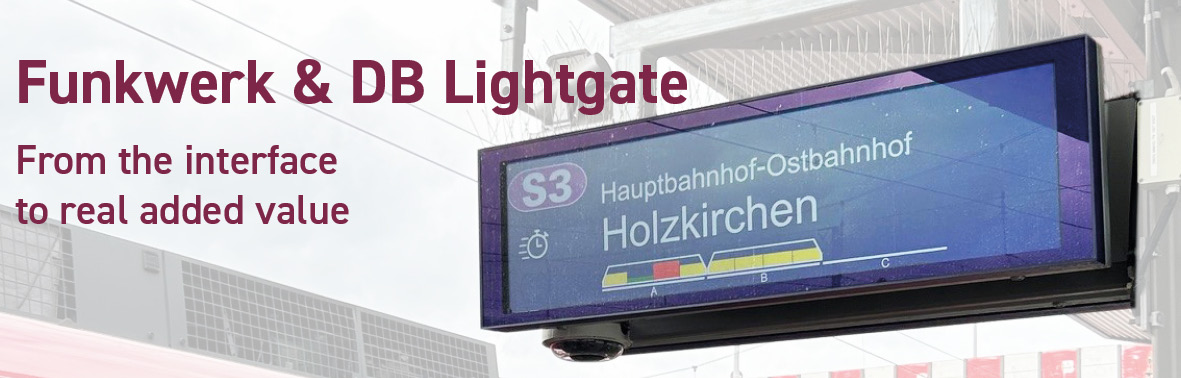
Now imagine this: Passengers can see which carriages still have space right on the platform. They distribute themselves evenly. The doors close on time. Operations run smoothly.
This is exactly what DB Lightgate makes possible, and S-Bahn Munich is already implementing it.
On April 15, 2026, we will show you live how it works. No theory, just real-world practice: from technical integration and infrastructural requirements to a live demo of the passenger information system.
In the webinar, you will learn:
• How passengers can see in real-time on the platform which carriages still have space.
• How this shortens dwell times and improves operational processes.
• How we integrated DB Lightgate into the MARIS passenger information system at S-Bahn Munich.
• What infrastructural and technical requirements are necessary.
Your speakers: Amish Dalal (Funkwerk Systems GmbH) and Niklas Schulz (DB Lightgate, S-Bahn Hamburg GmbH).
Two dates are available for you to choose from:
- Wednesday, 2026-04-15, 11:00 AM (English) – Register now
- Wednesday, 2026-04-15, 2:00 PM (German) – Register now
Duration: 60 minutes including Q&A
Why we do this
Because as a technology partner for transport companies, we know: challenges are often similar, but every solution must fit individually. With this webinar, we want to share practical knowledge using a real-world application example – including technical details, challenges, and results. Our goal: you can make an informed decision on whether and how such solutions work for your transport company.
Secure your spot at the webinar now
- Wednesday, 2026-04-15, 11:00 AM (English) – Register now
- Wednesday, 2026-04-15, 2:00 PM (German) – Register now
You need to load content from reCAPTCHA to submit the form. Please note that doing so will share data with third-party providers.
More InformationYou are currently viewing a placeholder content from Turnstile. To access the actual content, click the button below. Please note that doing so will share data with third-party providers.
More Information